Monday, May 27, 2024

Dancing the Hula!


‘Olena (Yellow Ginger), the Hula Dancer

Birth Date: Mei 28, 2024 (05/28/24)


Aloha Mai

I come with love.


‘Olena’s Hula honors the miracle of creation.

Join her in her celebration of life’s joys and abundance!

Named after the beautiful sweet smelling yellow Ginger flower, ‘Olena dances the ancient Hawaiian Kahiko Hula.
The beautiful movements of her hands and body tell stories about the wonders of nature, the creation of the world and the Menehune Ohana (family).
‘Olena’s traditional Uli’ulis (feather gourds) add sound and excitement to her dance.


Her performance is a magnificent spectacle!


Tutu (grandmother) is ‘Olena’s Kumu Hula (Hula Teacher). She taught her the powerful movements of the Kahiko Hula.
Together, Tutu and ‘Olena crafted the Ulu’ulis out of wood, bright red and yellow feathers. Tutu blessed the Ulu’ulis with Hawaiian salt and special prayers. They are sacred now. They were created for ‘Olena and only she is allowed to touch them.
Tutu also hand crafted the traditional yellow hula skirt with a matching top and panties. Tutu wove yellow feather leis for ‘Olena’s ankles.
In Hawaii the Hulu (feather) represents spiritual strength, unity and love. It is believed to link to the divine.
Last Tutu put 2 red Plumeria flowers in ‘Olena’s hair.
All these precious things were Tutu’s gifts of Aloha (Love) to her Mo’opuna Wahine (granddaughter).

‘Olena is a 10” tall cloth doll who was individually handcrafted on the Big Island of Hawaii with the greatest love and respect for all that is Hawaii. Her body is made out of doll skin and stuffed with high quality poly fill. The body is wired for flexibility. The eyes and mouth are intricately embroidered onto the face. All accessories were individually handcrafted.
‘Olena is not a dress up doll. All clothing and accessories are sewn and/or glued onto her.

Doll care: Gently brush the dolls and their clothing with a soft toothbrush to remove dust. Always brush the faces and bodies upwards towards the hair. You may gently finger comb her hair.

‘Olena is an original design and comes with a booklet and certificate of authenticity.
She is a collector’s item bringing you the spiritual power of Hawaii.

‘Olena is a one of a kind Hawaiian Art Doll. Every bit of her has been lovingly handcrafted to create a new friend who will last a lifetime.

‘Olena is ready to be your new friend and dance her way into your heart.

‘Olena's Hula teaches about all that is sacred.


Saturday, May 18, 2024

La'amaomao, Hawaiian Goddess of the Winds


La'a, Goddess of the Wind
Birth Date: Malaki 6, 2023 (03-06-23)

Allow the fresh breezes of La'a to guide you towards
your full potential.

It is a glorious summer day with the perfect Makani (wind) for La'a to fly her beloved Lupe (kite).
She runs along the beach with her black hair flying in the wind. Her kite is sailing, dancing, whirling and swirling in the air.

It is so much fun! La'a could fly her Lupe forever.

La'a's name means 'Sacred'. She is named after La'amaomao, the Goddess of the Winds.
La'a's Amakua (guardian spirit) is the Hīhīmanu (sting ray).
La'a's Kuku (grandfather) built her kite in the image of Hihimanu to enhance La'a's connection to her Aumakua.

La'a’s Tutu (grandmother) wove her Mana (spiritual energy) and Aloha (love) into La'a's green feather Haku (head lei) and ankle leis. The Hulu (feather) is believed to link to the divine.
Tutu also crafted a Kukui nut and Leho (cowrie) shell lei for La’a. Kukui represents inner light and spirit revealing itself. Leho shells invoke the protection of the spirits in connection with the strength and the power of the ocean.
Then Tutu sewed La'a’s traditional red and yellow Pa’u hula skirt with a matching top and a Bird of Paradise design.
All these things were Tutu's and Kuku's gifts of Aloha (Love) for their beloved Mo’opuna Wahine (granddaughter).

La’a is a 7” tall cloth doll who was individually handcrafted on the Big Island of Hawaii with the greatest love and respect for all that is Hawaii. Her body is made out of doll skin and stuffed with high quality poly fill. The body is wired for flexibility. The eyes and mouth are intricately embroidered onto the face.
All accessories were individually handcrafted.
La’a is not a dress up doll. All clothing and accessories are sewn and/or glued onto her.

Doll care: Gently brush the dolls and their clothing with a soft dry toothbrush to remove dust. Always brush the faces and bodies upwards towards the hair. You may gently finger comb her hair!

La’a is a one of a kind display doll handcrafted by Hawaiian Dolls. She is a collector’s items bringing you the spiritual power of Hawaii. La’a comes with her story and a certificate of authenticity.

La'a reflects the divine Mana of the Hawaiian winds.
She is ready to be your new friend and fly into your heart.


Monday, April 29, 2024

Poi, Sacred, Life-Giving Food of Hawaii

Taro

Taro was used to make Poi from the corm of the Taro plant, which was a sacred, life-giving, ancestral food for native Hawaiians. 80 different species of Kalo or Taro are known in Hawaii. All parts of the Taro plant were used; as food or for religious and medicinal purposes. The potato shaped Taro bulb was cooked and pounded to a paste with the Ku'i 'ai pohaku.

The Ku'i 'ai Pohaku, or poi pounder, is the most valuable Hawaiian stone tool. It is carved out of a gray lava. For many hours ancient Hawaiians shaped it patiently with a hammer stone and polished it with another stone until the shape of a cylindrical neck topped by a knob and with a flared bottom was completed.

Traditionally, the making of Poi was a ceremony of life that brought the Ohana (family) together. Ohana literally means 'all from the shoots'. The Kalo or Taro corm grows the Keikis (children) of the plant. Planting the Taro, making and eating Poi, all symbolize a deep family bond. Everybody in the Ohana worked in the Taro patch in the spirit of Hoolaulima (working together).

The Hawaiian saying 'take time to eat Poi' means 'slow down and enjoy life and health'.

Due to the many health benefits of Poi, ancient Hawaiians were one of the healthiest races on earth. Up to this day Poi is used for the prevention and cure of many health conditions.

Poi is a sacred food of great cultural significance.

The sacred Pohaku and life-giving Poi inspired the creation of Menehune Boy
Kalo, the Poi Maker.
Kalo (Taro), the Poi Maker 

Birth Date: ‘Apelila 24, 2024 (04-24-24)

Kalo inspires us to enjoy life to the fullest.

In the spirit of Hoolaulima (working together), Kalo was working with his Ohana (family) in the Taro patch all day long. Everybody was laughing, singing, telling stories and enjoying each other's company. Now the Taro bulb is ready to be cooked and then pounded into sacred, life-giving Poi.

Poi is Kalo's favorite food. It is a lot of work to pound the cooked Taro into a paste with his Ku'i 'ai pohaku (Poi pounder). But it is worth every minute of it because Poi just tastes so good. Kalo is named after the Taro plant which produces this delicious dish.

Kalo’s life-giving Taro is a blessing.

Kalo and his Kuku (grandfather) carved the Ku'i 'ai pohaku out of stone. For many hours they shaped it patiently with a hammer stone and polished it with another stone until the shape of a cylindrical neck topped by a knob and with a flared bottom was completed. Afterwards they carved a wooden bowl to mash the Taro in.


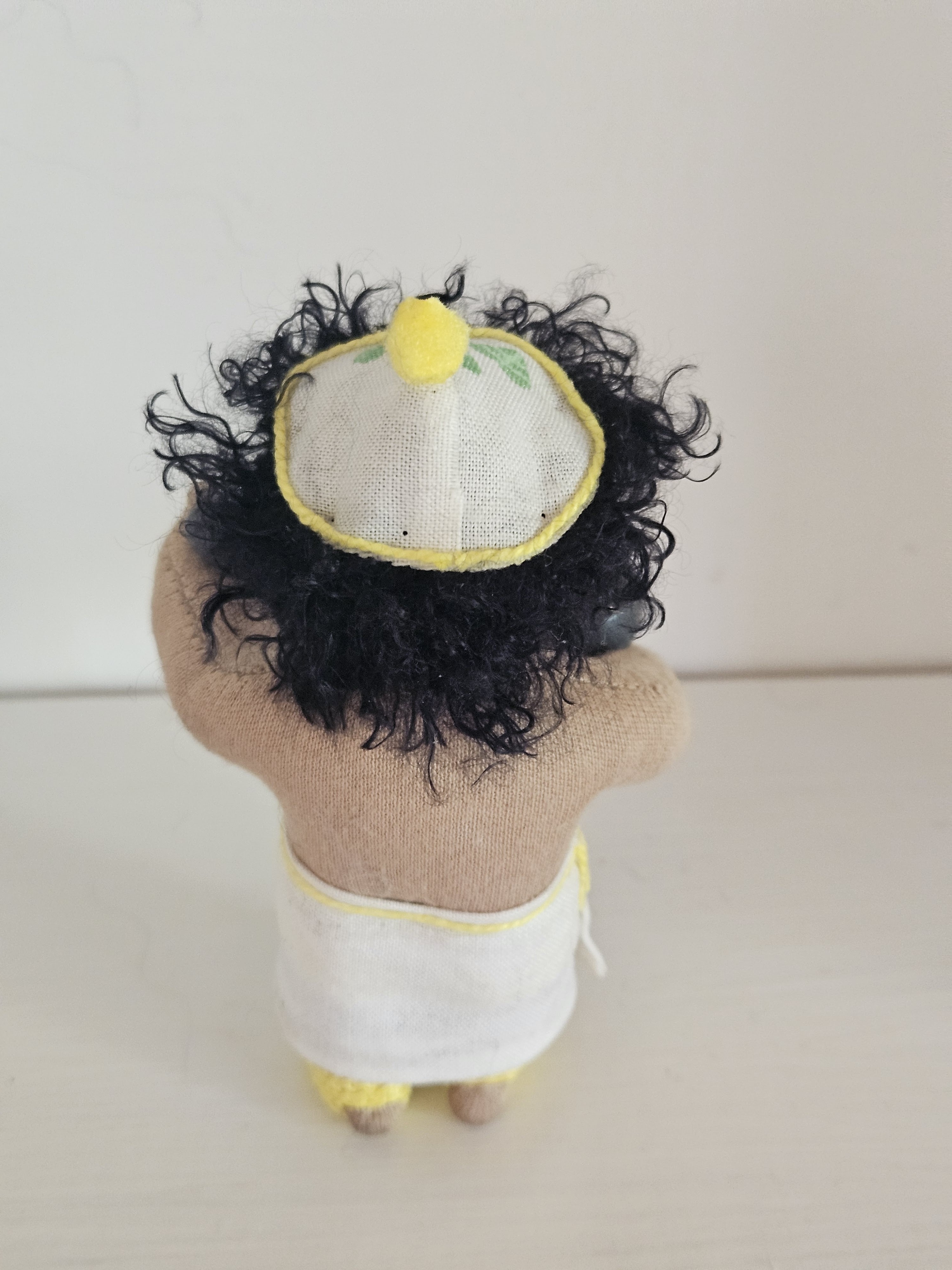
Kalo's’s Tutu (grandmother) sewed his white Malu (wraparound) and matching hat. She drew and Taro leaves on the Malu and hat. Tutu also crocheted yellow underwear and little shoes.

All these things were Kuku's and Tutu’s sacred gifts of Aloha (Love) to their beloved Mo’opuna Kane (grandson).

Kalo is about 4” tall fitting in the palm of your hand. The body is made out of doll skin and wired for flexibility. The eyes and mouth are intricately embroidered onto the face. Kalo has little hands, feet, ears, buttocks, and a belly button. All accessories were individually handcrafted.

Kalo is not dress a up dolls. All clothing and accessories are sewn and/or glued onto him.

Doll care: Gently brush the dolls and their clothing with a soft dry toothbrush to remove dust. Always brush the faces and bodies upwards towards the hair.

Kalo is a one of a kind Hawaiian Art Doll. Every bit of him has been lovingly handcrafted to create a new friend who will last a lifetime.

Kalo is a display doll and collector’s item bringing you the spiritual power of Hawaii. He comes with his story and a certificate of authenticity.

Kalo reflects the life-giving Mana of the Taro.

He is ready to be your new friend and pound his way into your heart.

www.Etsy.com


Saturday, March 16, 2024

Queen Liliuokalani the Fire from Heaven


Queen Liliuokalani, the Fire from Heaven


The Story of the First and Last Queen Regent of Hawaii


Queen Liliuokalani’s Manao (motto) was:

"E ʻonipa'a i ka 'imi na'auao" (Be steadfast in the seeking of knowledge).

 As the last reigning queen of the Kingdom of Hawaii, Queen Liliuokalani was born Lydia Kamakaeha on September 2, 1838 to a high chief and chieftess. When she became queen at the age of 60, she took on the name Liliuokalani.

As was common among Hawaiian royalty, Liliuokalani was adopted at birth by Abner Paki and his wife, Laura Konia. She received an education at the Chief’s Children’s School where she learned to speak English fluently, and traveled Europe and America. This exposure to western art and culture influenced much of the more than 160 songs that she composed in her lifetime, many of which are still frequently played throughout the islands today.

Queen Liliʻuokalani is remembered for her many musical compositions, including the famous song Aloha ‘Oe (Farewell to Thee). Many of these were written during her imprisonment after she abdicated her throne, and they express a deep love of her land and people. Her compositions were compiled into The Queen’s Songbook in 1999.

 "To compose was as natural to me as to breathe; and this gift of nature, never having been suffered to fall into disuse, remains a source of the greatest consolation to this day."


 Ke Aloha O Ka Haku, the Queen’s Prayer

`O kou aloha no

Aia i ka lani

A `o Kou `oia `i`o

He he molelo ho`i


Ko`u noho mihi `ana

A pa`ahao `ia

`O `oe ku`u lama

Kou nani ko`u ko`o


Mai nana `ino`ino

Na hewa o kanaka

Aka e huikala

A ma`ema`e nô


No laila e ka Haku

Ma lalo o kou `eheu

Ko makou maluhia

A mau loa aku no

`Amene


Your loving mercy

Is as high as Heaven

And your truth

So perfect


I live in sorrow

Imprisoned

You are my light

Your glory, my support


Behold not with malevolence

The sins of man

But forgive

And cleanse


And so, o Lord

Protect us beneath your wings

And let peace be our portion

Now and forever more, Amen

Hawaii’s Story by Hawaii’s Queen Liliuokalani Washington, D.C. Feb. 9, 1898 tells the story of her life, the overthrow of the monarchy, her attempts to reclaim it, and Hawaii during that time. It remains a key work in Hawaiian history. "I was a studious girl; and the acquisition of knowledge has been a passion with me during my whole life."

In 1862 Liliuokalani married John Owen Dominis, who in time became the governor of Oahu and Maui.

As the elder sister to King David Kalakaua, Liliuokalani became the queen of the Kingdom of Hawaii upon the King’s death in 1891.

A Fight for Hawaii’s Freedom

One of Queen Liliuokalani’s main goals was to reestablish the power and sovereignty of the monarchy that her brother had to give up.

When Liliuokalani inherited the throne, she took repealed the Bayonet Constitution, which deprived the authority of the Hawaiian monarchy and gave power to foreigners. She drafted a new constitution which would restore the power to Hawaii.

"Never cease to act because you fear you may fail."

In January 1895 Liliuokalani was arrested following the failed Counter-Revolution in Hawaii. At her trial Liliuokalani denied any knowledge of the revolution but was found guilty and sentenced to five years of hard labor in prison and a fine. That sentence was later commuted to imprisonment to an upstairs bedroom of Iolani Palace. Iolani Palace stands to this day as the only royal residence on American soil.

In 1896, Liliuokalani was granted a full pardon by the now annexed Republic of Hawaii. She resumed her attempts at appealing annexation and traveled to the United States many times in the process. Despite her efforts, Hawaii became a Territory of the United States in 1898 and in one last push in 1910 Liliuokalani unsuccessfully sued the United States government for the loss of the Hawaiian crown land.

On January 16, 1893, United States troops invaded the Hawaiian Kingdom without just cause, which led to a conditional surrender by the Hawaiian Kingdom’s executive monarch, Her Majesty Queen Lili‘uokalani, the following day. Liliʻuokalani believed in peaceful resistance. She did not want the blood of Hawaiian people to be shed.

"It was the intention of the officers of the government to humiliate me by imprisoning me, but my spirit rose above that. I was a martyr to the cause of my people, and was proud of it."

Her conditional surrender read:

“I, Liliuokalani, by the grace of God and under the constitution of the Hawaiian Kingdom, Queen, do hereby solemnly protest against any and all acts done against myself and the constitutional Government of the Hawaiian Kingdom by certain persons claiming to have established a provisional government of and for this Kingdom….”

"Love of country is deep-seated in the breast of every Hawaiian, whatever his station. The cause of Hawaiian independence is larger and dearer than the life of any man connected with it."

"I have pursued the path of peace and diplomatic discussion, and not that of internal strife."

The last queen of Hawaii lived in Washington Palace until her death in 1917 as a private citizen.

Liliuokalani still remains an icon and much beloved by the Hawaiian people. She was the first activist for Hawaiian culture and sovereignty, a movement that still exists to this day. Her legacy also lives on in the Queen Liliuokalani Trust Fund, which works to serve the children of Hawaii.

“Aloha 'Oe, Farewell to Thee . . . 

One fond embrace before I now depart. Until we meet again."

"All things in this world are two: in heaven there is but One.


Hawaiian Art doll Liliuokalani was created in honor of Queen Liliuokalani, the Fire from Heaven.


Friday, March 8, 2024

Hawaiian Goddess and God of the Ocean, Namaka and Kanaloa

Namaka and Kanaloa, Hawaiian Goddess and God of the Ocean

Kanaloa offers a solid foundation of security, strength and health.

Kanaloa channels the Mana of healing.


Namaka's spirit lives within the water and the sacred creatures of the sea.

She is filled with Pono (goodness) and possesses the Mana of healing.

With her arms stretched to the sky, Namaka is standing on the shore of Punaluu Black Sands Beach honoring the Mana (spiritual energy) of the ocean.

Namaka, the Goddess of the Sea rules over the cool, majestic waves of the ocean.

Namaka’s sister Pele, the Volcano Goddess gives birth to new rock formations and land with her hot lava and flaming spirit. Namaka cools the lava with her healing waters allowing it to become newly birthed lands.

In Hawaiian mythology Kanaloa is the god of the ocean and the ocean winds. He is one of the four major gods of Hawaii: Kane, Kanaloa, Ku and Lono. Kanaloa was strongly connected with Kane, the creator of all life. When the people in old Hawaiians built a canoe they would invoke Kane's blessing for the building and Kanaloa's for its sailing.

On their journeys together Kanaloa and Kane would share the sacred drink of 'Awa (drink of the gods). Striking the ground with their staffs they caused hidden springs of fresh water to burst forth.

Ki'is (statues) show Kanaloa wearing a headdress that touches the ground connecting the conscious and unconscious mind, integrating the upper and lower selves.

Statues of Kanaloa feature him with round eyes, unlike those of any other representations of the gods. According to a Kauai tradition, if you could look into the eye of Kanaloa you would see the symbol of Pono (goodness) and be healed. Kanaloa is a healer god. One of his Kinolaus (forms) is the He'e (octopus), which was believed to make sickness flee.

Ka-na-loa means 'grounded'. Kanaloa reminds us 

that a solid foundation brings security, strength and healing.

www.HawaiianCollectibleMenehuneDolls.com


Sunday, December 3, 2023

Ku’ula, the Fish God of Hawaii

Ku’ula, the Fish God of Hawaii


‘Ama’ama by Sam Alama
He aloha ē ka iʻa lā
ʻAi a ka ʻamaʻama
ʻAi a ka iʻa lā
ʻAi a ka lāwalu
ʻAi a ka hoʻomoemoe

I love fish
To eat mullet
To eat fish
To eat it broiled in ti leaves
Eat, then sleep

Sam Alama’s song ‘Ama‘Ama” sings praises of Hawaii’s tasty fish. 

Hawaii’s aquaculture is most important as fish has always been the main source of protein.

The greatest fisher of ancient times was Ku'ula-kai who was deified as the fishing god.
It was said, Ku’ula-kai was possessed by Ku, the Hawaiian God of war, politics, farming and fishing. Ku'ula-kai had great Mana (spiritual power) over the fish. This power allowed him to direct, control and influence all of the fish of the sea whenever he pleased. His Mana Kupua (supernatural power) empowered him to attract and multiply fish.
When he was in human form, he was devoted to catching fish for his Ohana (family). His big canoe was always filled it to the top.

Ku‘ula lived with his wife Hina and their son ‘Ai‘ai in Hana on the island of Maui. There he created the first fish pond in Hawaii where he kept all kinds of fish.
Ku‘ula honored the Akuas (gods) by offering his first fish to a small Ko’a (fishing shrine). He always caught all the fish he needed and shared his catch with everybody in the village.

To this day, locals honor Ku’ula’s teachings by preserving old and creating new fishing ponds. The concept of conserving and sharing the fish we catch enables the sustainability in our communities.

Hawaiian Art Doll Kaimana (Ocean Power) was created in honor of Ku’ula, the Fish God.

Kaimana (Ocean Power), the Fisher Boy

Birth Date: Kekemapa 1, 2023 (12-1-23)


Kaimana teaches us to see with the heart and act with compassion.

He aloha ē ka iʻa lā
ʻAi a ka ʻamaʻama
ʻAi a ka iʻa lā

I love fish
To eat mullet
To eat fish

Kaimana, the Fisher Boy, honors Ku’ula the Hawaiian Fish God.

Carrying his scoop net to the gentle waters in the bays of Punalu’u Black Sands Beach, Kaimana gets ready to catch dinner for his Ohana (family) and himself. First, he says a prayer of heartfelt thanks for nature’s abundant offerings. He then humbly asks permission for just enough fish to come to his net so that he can feed himself and his Ohana.

Kaimana has a balanced, harmonious relationship with nature. He knows that if he takes only what he needs, it will always be given freely. Kaimana never forgets to honor the Akuas (gods) by offering his first fish to the Ko’a (fishing shrine). Resting on a big piece of coral, Kaimana gratefully admires his abundant catch of the day.

Kaimana 's Mana (spiritual energy) radiates Aloha.

Kaimana is most generous. Nothing makes him happier than sharing the fish he caught with his Ohana and the people in the village, so that everybody can have an abundant, delicious dinner. Seeing their joy and appreciation is the greatest gift to him.

Kaimana knows that the more he gives, the more he will receive.

Kaimana’s Tutu (grandmother) sewed his blue Malu (wraparound) with a Honu (turtle) design and crocheted his brown tabi shoes. Tutu crafted a conch and cowrie shell lei for Kaimana. In Hawaii the Pu (Conch Shell) is believed to invoke blessings of divine Mana and provide protection from all harm.

Kaimana 's Kuku (grandfather) crafted and blessed his yellow scoop net which always catches just enough fish for the Ohana’s dinner.

All these things were Kuku's and Tutu’s sacred gifts of Aloha (Love) to their beloved Mo’opuna Kane (grandson).

Kaimana is a 10” tall cloth doll. He was individually handcrafted on the Big Island of Hawaii with the greatest love and respect for all that is Hawaii.
The body is made out of doll skin, stuffed with high quality poly fill and wired for flexibility. The eyes and mouth are intricately embroidered onto the face giving the doll a unique personality. All accessories were individually hand crafted.
Kaimana is not dress up dolls. All clothing and accessories are sewn and/or glued onto him.

Doll care: Gently brush the dolls and their clothing with a soft toothbrush to remove dust. Always brush the faces and bodies upwards towards the hair. Do not brush the hair!

Kaimana is a one of a kind Hawaiian Art Doll and comes with a booklet and certificate of authenticity. He is a display doll and collector’s item bringing you the spiritual power of Hawaii.
Every bit of Kaimana has been lovingly handcrafted to create a new friend who will last a lifetime.


Kaimana is ready to be your new friend and fish his way into your heart.

Kaimana conveys a balanced, harmonious relationship with nature.


Saturday, November 11, 2023

Mele Kalikimaka from Santa and Mrs. Claus!


Santa Claus and Mrs. Claus

Birthdate: Nowemapa 11, 2023 (11-11-23)


Mele Kalikimaka! (Merry Christmas!)

May all that is meaningful, beautiful and joyful be yours throughout

this holiday season and the new year!


Hawaiian Santa is a sight to see as he comes surfing into Waikiki.

Hawaiian Santa wears a great big hat and climbs the window into your grass shack

He dances the hula around the Christmas tree bringing 

lots of presents for you and for me.

Hawaiian Santa goes around the isle and dances the hula with a great big smile

He waves Aloha with a Christmas cheer

Mele Kalikimaka and Happy New Year!


This year Kanakaloka (Santa Claus) and Mrs. Claus came to Hawaii for the Holidays. Together they spread the magical spirit of Christmas over the Islands. 

There are no limits to their Mana of Aloha.


Kanakaloka pulls his surfboard loaded with Makanas (gifts) of Aloha for all: a sacred Ipu (gourd) with Holly Berries, a Pu (conch shell), a traditional secret Ho'okupu (present) wrapped in Ti leaves, Mai'as (bananas) and Kahikis (pineapples).

Mrs. Claus just finished helping the elves bake Christmas cookies. Now it's time to relax. She took her basket, lined it with a handmade quilt and some Holly Berries, walked down to the beach and started collecting some of the most beautiful seashells. 


Kanakaloka wears a blue Aloha shirt with a surfboard design, red shorts and a Santa hat. 


Mrs. Claus wears a traditional Muumuu with a Poinsettia design, a straw hat with a green feather lei, green crocheted shoes and a shell lei. And of course, she's wearing her glasses. 

Santa Claus and Mrs. Claus are 10” tall cloth dolls who were individually handcrafted on the Big Island of Hawaii with the greatest love and respect for all that is Hawaii. Their bodies are made out of doll skin and stuffed with high quality poly fill. The bodies are wired for flexibility. The eyes and mouth are intricately embroidered onto the face. All accessories are individually hand crafted. Santa Claus and Mrs. Claus are not dress up dolls. All clothing and accessories are sewn and/or glued onto them, except for the surfboard which can be removed.


Doll care: Gently brush the dolls and their clothing with a soft dry toothbrush to remove dust. Always brush the faces and bodies upwards towards the hair. Do not brush the hair!

Santa Claus and Mrs. Claus are original designs and come with a booklet and a certificate of authenticity.

Santa Claus and Mrs. Claus are one of a kind Hawaiian Art Dolls. They are display dolls and collector’s items bringing you the spiritual power of Hawaii. Every bit of Santa Claus and Mrs. Claus has been lovingly handcrafted to create new friends who will last a lifetime. 


Kanakaloka and Mrs. Claus wish you a season filled with light and laughter.

They are ready to be your new friends and bless 

your home with the Aloha spirit of Hawaii.

www.Etsy.com